

Chip Set
The AIoT Edge Analytics Chip Set Layer provides the core hardware needed for running operating systems, containers, and edge AI applications. It combines CPUs, GPUs, NPUs, and microcontrollers for fast and efficient processing. Built-in wireless modules like WiFi, Bluetooth, NB-IoT, and 5G enable smooth device-to-cloud communication. Low-power chip designs help save energy, making them ideal for battery-based devices.

Software Define Security
The Software Defined Security & Runtime layer ensures a secure operating environment for edge devices by using Docker/Podman containers and stable operating systems (Linux/Android/Windows CE). It supports hypervisors to run multiple OS or virtual machines on the same hardware. Secure Boot and Chain of Trust verify trusted software execution, while cryptography and secure storage protect sensitive data and device credentials..
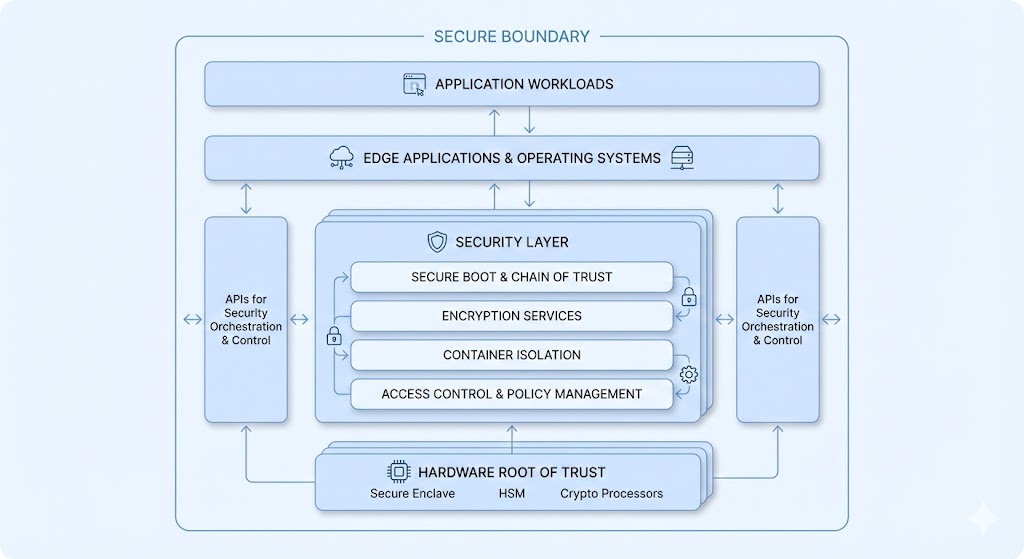
Edge Stack

1
Core Data Collection & Processing
- IoT Client: Manages general IoT communication and real-time data exchange across connected devices
- Device Shadow Client: Synchronizes digital twins of devices for remote state management and monitoring
- Diagnostic Server: Collects health metrics, performance data, and diagnostic information for analysis
- Edge Database: Stores data locally for immediate processing, reducing cloud latency and bandwidth consumption
- Benefit: Enables real-time analytics and decision-making at the edge without cloud dependency
2
Device Management & Lifecycle
- Device Provisioning: Initial setup and configuration of new devices joining the network
- Device Registration: Registers devices with the system and maintains device identities
- Device Manager: Oversees complete device lifecycle from deployment through retirement
- Health Manager: Continuously monitors device health, status, and performance metrics
- Benefit: Provides centralized control, visibility, and proactive maintenance across distributed edge devices.
3
Remote Updates & OTA Capability (FOTA Stack)
- OTA Client: Facilitates firmware and software update requests on edge devices
- Downloader: Manages secure firmware package downloads to target devices
- Orchestrator: Coordinates and schedules update rollouts across multiple devices simultaneously
- Inventory Manager: Tracks firmware versions, device compatibility, and update history
- Remote Updater: Pushes updates remotely with rollback capabilities and deployment control
- Benefit: Eliminates manual update processes, ensures consistent firmware versions, and reduces downtime
4
Protocol Integration & Security
- Protocol Converter: Translates between industrial protocols (Modbus, Backnet, UDS) and standardized edge protocols (MQTT/DDS/ROS/SOME/IP)
- Edge Security: Implements encryption, authentication, and access control specific to edge environments
- Interoperability: Enables seamless communication across heterogeneous hardware and legacy systems
- Data Protection: Safeguards device integrity and sensitive data throughout the edge computing ecosystem
- Benefit: Bridges legacy industrial systems with modern edge architecture while maintaining security
Edge Analytics Apps

4
Cloud Backend

1
Centralized Data Storage & Management
- Collects processed and filtered data from edge devices
- Stores long-term historical data for analysis
- Uses time-series databases for sensor data
- Supports NoSQL databases for flexible device data
- Enables data backup, recovery, and scalability
2
Advanced Analytics & AI Processing
- Performs complex analytics beyond edge capability
- Runs AI/ML models for prediction and optimization
- Analyzes data across multiple devices (fleet analytics)
- Identifies trends, patterns, and anomalies over time
- Supports business intelligence and decision-making
3
Device, User & System Management
- Handles device onboarding and registration
- Maintains device state using Device Shadow/Digital Twin
- Manages firmware updates and configurations
- Monitors device health and performance
- Supports role-based access for users and admins
4
Scalability & Resource Efficiency
- Optimized for low-power edge hardware
- Works within limited CPU, memory, and energy
- Supports large-scale IoT deployments
- Enables deployment in remote and rural locations
- Improves overall system performance
Applications

1
User Interface & Access Layer
- Acts as the front-end of the AIoT system
- Provides interaction between users and IoT devices
- Available as web, mobile, and desktop applications
- Ensures easy access to data and controls
- Designed for both technical and non-technical users
2
Monitoring, Visualization & Alerts
- Displays real-time and historical data
- Shows device health, status, and performance
- Uses dashboards, graphs, charts, and maps
- Generates alerts, warnings, and notifications
- Helps users quickly identify critical conditions
3
Device Control & System Management
- Allows remote control of devices and systems
- Sends commands and configurations to cloud backend
- Supports scheduling, automation, and rule execution
- Helps manage large-scale IoT deployments
- Reduces need for physical device access
4
Decision Support & Business Integration
- Uses AI/analytics results for informed decisions
- Supports reporting and predictive insights
- Integrates with enterprise systems (ERP, CRM, etc.)
- Improves operational efficiency and productivity
- Enables data-driven business strategies
Over The Air Updates, Feature on Demand Server
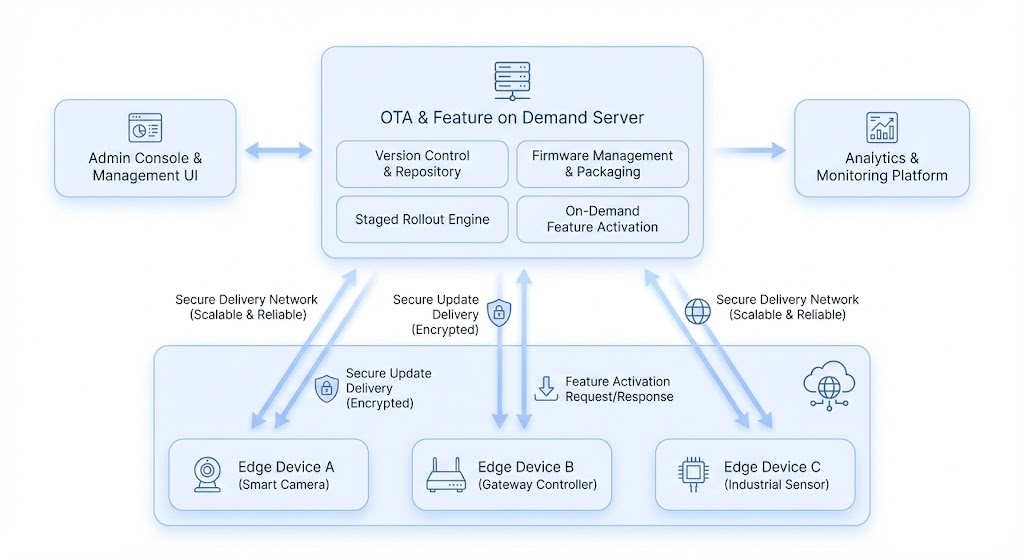
1
Remote Update Delivery
- Sends firmware, software patches, and bug fixes remotely
- No physical access to devices required
- Useful for large-scale and remote IoT deployments
- Reduces maintenance time and operational cost
2
Secure Update Mechanism
- Uses cryptographic signatures for authenticity
- Secure Boot verifies firmware before execution
- Encrypted communication (TLS/DTLS)
- Prevents malware and unauthorized updates
3
Feature on Demand Enablement
- Enables/disables features via licenses
- No need to replace full firmware
- Supports subscription and premium features
- Same hardware supports multiple product variants
4
Centralized Control & Lifecycle Management
- Manages firmware versions and compatibility
- Supports staged rollout and rollback
- Integrates with Device Shadow/Digital Twin
- Ensures reliable and controlled device updates
Device Shadow / Digital Twin

1
Virtual Representation of Physical Device
- Cloud-based digital copy of a physical IoT device
- Stores device configuration, status, and metadata
- Works even when the physical device is offline
- Removes need for direct device–application connection
- Enables asynchronous communication
- Provides a single source of truth for device state
- Scales easily for thousands or millions of devices
2
Desired, Reported & Delta State Management
- Desired state defined by cloud or applications
- Reported state sent by device after execution
- Delta state shows mismatch between desired and reported
- Automatically triggers actions when states differ
- Ensures configuration consistency across devices
- Supports partial updates of device properties
- Simplifies state synchronization logic
3
Offline Operation & Reliable Synchronization
- Cloud can send commands even when device is offline
- Shadow stores commands until device reconnects
- Device pulls latest desired state on reconnection
- Eliminates command loss due to network failure
- Ideal for battery-powered or intermittently connected devices
- Enables delayed execution without manual retry
- Improves system reliability in poor network areas
4
Centralized Device Management & Integration
- Enables remote monitoring of device health and status
- Integrates with OTA Updates and Feature on Demand
- Supports intelligent firmware update scheduling
- Helps manage complete device lifecycle remotely
- Provides audit logs and state history
- Reduces operational and maintenance costs
- Enhances scalability and operational efficiency
Privacy
Company Address:-R.S.Nom.1376,D-Ward, Kagal, Kolhapur, Maharashtra, 416216
Email:-admin@grdtechsolutions.com
 GrdTechSolutions