
Edge Intelligence Cloud

Platform and Architecture
- Multi-Tenant Dashboard: Web-based dashboard allowing multiple organizations to manage and monitor their device fleets independently.
- Cloud-Native FOTA PaaS: Centralized cloud platform for reliable firmware over-the-air update management.
Security & Device Management
- Update Validation: Strict verification of firmware packages to prevent unauthorized or corrupted updates.
- Secure Device Management: Strong device registration, authentication, and encrypted communication.
Compatibility & Connectivity
- Cross-Platform Support: Works across Linux, Android, and Windows CE based devices.
- Multi-Protocol Support: Supports MQTT, DDS, ROS, and SOME/IP for wide IoT ecosystem integration.
Functional and Non-Functional Requirements
Functional
These define what the system must do:
- Secure Device Registration: Devices must register securely with the platform via the AIOTDrm (Device Registration) module, ensuring only authorized devices can connect.
- Encrypted and Verified Firmware Updates: All firmware updates must be encrypted during transmission and verified upon receipt to prevent tampering and ensure integrity.
- Dashboard for Update Management: The AIOTFotaCMD dashboard must provide functionalities for scheduling updates, monitoring their progress in real-time, and initiating rollbacks if an update fails or causes issues.
- Edge Device Protocol Conversion and Orchestration: Edge devices must be capable of converting between different communication protocols and orchestrating the update process locally.
Non-Functional
These define the quality attributes of the system:
- Scalability: The platform must be designed to support and manage firmware updates for thousands of IoT devices concurrently, with the ability to scale further as device fleets grow.
- Security: End-to-end encryption, secure boot mechanisms, and comprehensive update validation are critical to protect devices and data from unauthorized access and malicious updates.
- Reliability: The system must incorporate fail-safe mechanisms to handle interrupted updates gracefully, ensuring devices are not bricked and can recover from partial or failed updates.
- Performance: Low-latency communication and efficient update delivery are essential to minimize downtime and ensure timely deployment of critical updates.
Cloud Edge Update Architecture

Cloud Stack
This layer manages firmware updates, security, and delivery from the cloud
- Cloud Security (AIOTCSec):
- Protects all cloud services using encryption, authentication, and secure communication with devices.
- Firmware Update Server (AIOTFOTA Srv):
- Plans and manages FOTA campaigns, device groups, update schedules, and targeting rules.
- Eclipse Hawkbit:
- Open-source OTA backend used to control update workflows, track update status, and manage devices.
- FOTA Dashboard (AIOTFotaCMD):
- Web-based control panel to start updates, monitor device status, set policies, and view update history.
- Content Delivery Network (CDN):
- Delivers firmware files quickly to devices worldwide with low delay and reduced bandwidth usage.
- Update Policy Management:
- Defines rules like update time windows, forced/optional updates, retry limits, and device conditions (battery, network).
- Monitoring & Analytics:
- Tracks update progress, success/failure rates, device health, and generates reports for administrators.
- Scalability & Multi-Tenant Support:
- Supports thousands of devices and multiple customers/projects from the same cloud platform without performance issues.
AIOTFota Edge Stack
This layer runs inside the device and performs the actual firmware update.
- OTA Client (Hawkbit Client):
- Communicates with the cloud, checks for updates, and reports device status.
- Downloader:
- Downloads firmware safely from the CDN and verifies file integrity.
- Orchestrator:
- Controls the update process step-by-step (checks, install, reboot, rollback if needed).
- Inventory Manager:
- Stores device details like firmware version, hardware info, and update history.
- Device Registration (AIOTDrm):
- Ensures only authorized and genuine devices can connect to the cloud.
- Edge Security (AIOTESec):
- Secures firmware using encryption, secure boot, and trusted update verification.
- Remote Updater:
- Allows cloud-triggered updates and sends progress/status back to the dashboard.
- Protocol Converter:
- Converts protocols (MQTT, DDS, ROS, SOME/IP) so different devices can communicate smoothly with the cloud.
Communication Protocols
Enable reliable data exchange between edge devices and the cloud using standard protocols like MQTT, HTTP, DDS, and SOME/IP.
- MQTT:
- A lightweight messaging protocol ideal for IoT, used for asynchronous communication between cloud and edge.
- DDS (Data Distribution Service):
- A real-time publish-subscribe middleware for robust and high-performance data exchange.
- ROS (Robot Operating System):
- A flexible framework for writing robot software, often used for communication in robotics and automation.
- SOMEIP (Scalable service-Oriented MiddlewarE over IP):
- An automotive Ethernet protocol for service-oriented communication in vehicles, indicating support for specialized IoT domains.
- REST (HTTP):
- Used for synchronous API calls, particularly between cloud components and for content delivery.
Operating System & Chip Set
Provide the core runtime and processing capability of the device for performance and power efficiency.
- OS (Linux / Android / Windows CE):
- The underlying operating systems on which the AIOTFotaEdge stack components run, highlighting the cross-platform nature..
- Chip Set:
- The hardware foundation of the IoT devices.
- Edge Nodes:
- The actual IoT devices that receive and apply FOTA updates
- Hardware Abstraction Layer (HAL):
- Provides a standardized interface between the operating system and chipset, enabling portable and hardware-agnostic FOTA edge software deployment.
- Processing & Security Support:
- Chipsets integrate CPUs/MCUs with hardware security features such as secure boot, cryptographic accelerators, and trusted storage to ensure safe firmware updates.
Open-Source Platform: Eclipse Hawkbit

OTA Rollout Control
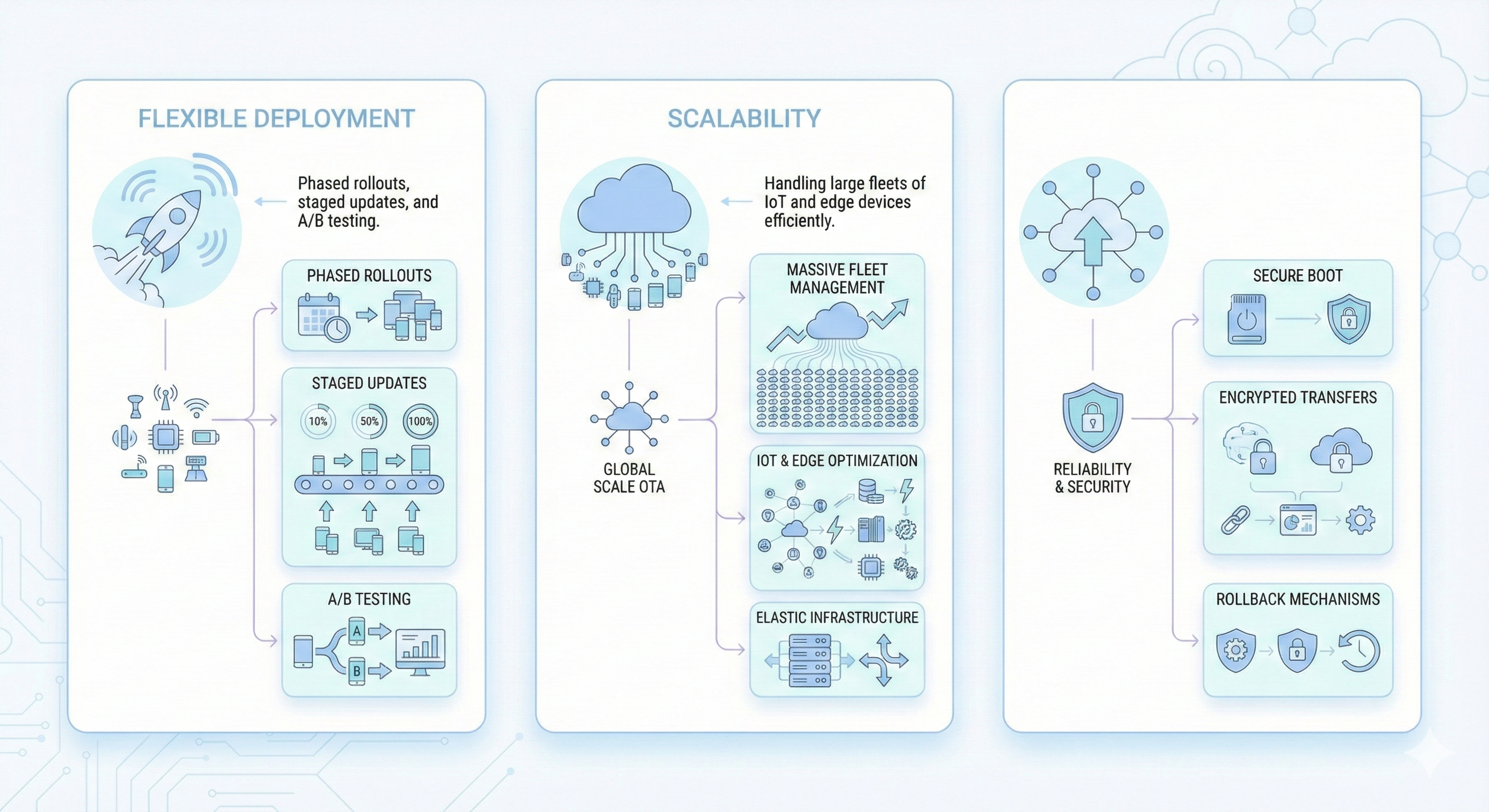
Rollout Management: Orchestrates the deployment of updates to device fleets.
Device Targeting: Allows defining specific criteria for which devices receive which updates
Update Status Tracking: Provides detailed feedback on the success or failure of updates.
Secure Update Delivery
Scalability: Designed to handle large numbers of devices.
Flexible Deployment: Supports various deployment strategies, including phased rollouts and A/B testing.
Secure Updates: Ensures only authenticated and verified firmware is deployed to devices.
Use Case: Automotive Infotainment System Update
Scenario:
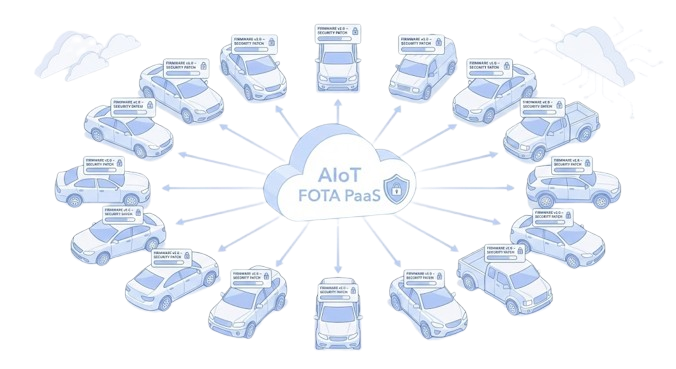
A major automotive manufacturer, “AutoDrive Inc.”, has deployed millions of vehicles equipped with advanced infotainment systems. A critical security vulnerability is discovered in the current infotainment firmware, and a new, patched version (Firmware v2.0) needs to be deployed to all vehicles globally.
Steps using the AIOTFOTA PaaS:
1.Firmware Preparation & Upload
- AutoDrive’s engineering team finalizes Firmware v2.0, ensuring it’s signed and encrypted.
- They upload Firmware v2.0 to the AIOTFOTA PaaS via the AIOTFotaCMD (FOTA Dashboard). The firmware is then stored in the cloud and distributed to the Content Delivery Network (CDN) for efficient global access.
2.Campaign Creation & Targeting
- An administrator at AutoDrive logs into the AIOTFotaCMD (FOTA Dashboard).
- They create a new FOTA campaign, specifying Firmware v2.0 as the target.
- Using the dashboard’s capabilities (powered by AIOTFOTA Srv and Eclipse Hawkbit), they define the target audience: all vehicles manufactured in 2023 and 2024.
3.Device Check-in & Update Notification
- When a connected vehicle starts or connects to the internet, its OTA Client (Hawkbit client) on the infotainment system periodically checks in with the Eclipse Hawkbit server in the cloud.
- Eclipse Hawkbit identifies that this vehicle is part of the Firmware v2.0 campaign and sends an update notification.
4.Secure Download
- Upon receiving the notification, the Downloader module on the vehicle’s infotainment system initiates the download of Firmware v2.0 from the nearest CDN node.
- The download is encrypted end-to-end, and the AIOTESec module on the edge ensures the integrity and authenticity of the downloaded package.
- Automatically restores the previous firmware if the update fails
5.Update Orchestration & Application
- Once downloaded, the Orchestrator module takes over. It performs pre-update checks (e.g., battery level, vehicle state, sufficient storage).
- If the update is successful, the Inventory Manager updates the vehicle’s firmware version metadata, which is then reported back to the cloud.
- The Orchestrator then initiates the firmware update process. This might involve rebooting the infotainment system into a secure update mode
6.Monitoring and Rollback
- If the update is successful, the Inventory Manager updates the vehicle’s firmware version metadata, which is then reported back to the cloud.
- AutoDrive’s administrator monitors the campaign progress in real-time. If a significant number of updates fail in a specific region or vehicle model, the administrator can pause the campaign or initiate a rollback to the previous stable firmware version for affected vehicles directly from the dashboard.
Benefits of this Use Case:
1
Rapid Response to Vulnerabilities
Critical security patches can be deployed quickly and efficiently across the entire fleet.
2
Cost Savings
Eliminates the need for costly and time-consuming manual recalls or dealership visits for software updates
3
Scalability
The PaaS can handle millions of vehicles, ensuring updates can be managed globally.
4
Security
End-to-end encryption and verification protect against malicious updates, crucial for automotive safety
5
Enhanced Customer Experience
Vehicles remain up-to-date with the latest features and improved performance without user intervention.
 GrdTechSolutions